You Cannot Build a High-Performing Organisation Without Developing Internal Capacity
A capacity development framework for organisations that want sustainable performance, leadership stability, and self-led teams.
In a world where pressure, complexity, and responsibility are constantly increasing, traditional “wellness” interventions no longer deliver sustainable results.
The Kaizen Wellness Method equips organisations with the internal strength their people and their performance truly depend on.
This is a fit conversation, not a sales call.
Direct Message From Jacque
For over 15 years, I’ve worked with thousands of people from every walk of life — moms and dads, entry-level professionals, high performers under immense pressure, founders, executives, and leadership teams across industries and around the world. I’ve seen leadership challenges from inside organisations that genuinely care about their people.
But one insight kept repeating itself:
People don’t fail because they lack willpower or desire — they fail because the demands they face exceed their internal capacity to handle pressure, complexity, and responsibility sustainably.
The clarity of this came into focus during a late-evening conversation at the kitchen table of one of the most extraordinary leaders I’ve ever met — a billionaire CEO who had built, sustained, and scaled performance over decades. We weren’t discussing tactics or motivation. We were talking about pressure, responsibility, and sustainability — what it really takes for someone to function not just for months, but for decades.
That experience and every transformation before and since taught me this:
Most well-intentioned organisational wellness programs fail because they address symptoms, not internal capability.
The Kaizen Wellness Method changes that by developing true internal capacity; mental clarity, emotional regulation, and physical resilience so people become self-led rather than reliant on external structure.
When enough individuals inside a company make that shift, the organisation itself becomes more capable, resilient, and sustainable.
— Jacque Visagie
Founder, Kaizen Wellness
This work is not about quick fixes or optics.
It’s about changing how people operate under pressure... that when lasting, strategic performance follows.

- Jacque Visagie Author, Speaker, C.E.O & Co Founder, Kaizen Wellness International.
Capacity Development for Sustainable Human Performance

Who This Is For
The Kaizen Wellness Method for Organisations is designed for companies that understand performance is no longer about output alone — it’s about capability.
This framework is for organisations that:
-
Operate in complex, high-responsibility environments
-
Are seeing burnout, disengagement, or leadership overload despite capable teams
-
Want employees who are autonomous, accountable, and self-led
-
Recognise that wellness should develop internal strength, not just deliver short-term metrics
-
Are committed to real performance transformation, not superficial engagement
Important:
If the goal is morale boosts, short-term wellness perks, or tick-box engagement, this framework is not the right fit.
This is for companies that want capability, not compliance.
The Problem Most Organisations Are Actually Facing
Most organisations believe they face a motivation, engagement, or resilience problem.
What they’re actually facing is a capacity problem.
As performance expectations rise, roles become more complex, and decision-making demands intensify, the internal capacity to meet those demands has not kept pace. This gap shows up as:
-
Persistent burnout that returns after interventions
-
High performers quietly disengaging or leaving
-
Leaders carrying emotional and cognitive load for others
-
Short-term output followed by instability
-
Repeated “wellness resets” with no long-term change
Most initiatives focus on relief. Very few focus on development. That’s why progress stalls.
The Core Insight
People can only perform sustainably at the level of their internal capacity.
Internal capacity determines how well someone can:
-
Think clearly under pressure
-
Regulate emotions instead of reacting
-
Recover from stress instead of accumulating it
-
Make consistent decisions without force
-
Sustain performance over time
Autonomy cannot be demanded. Resilience cannot be incentivised. Ownership cannot be outsourced. All three must be developed.
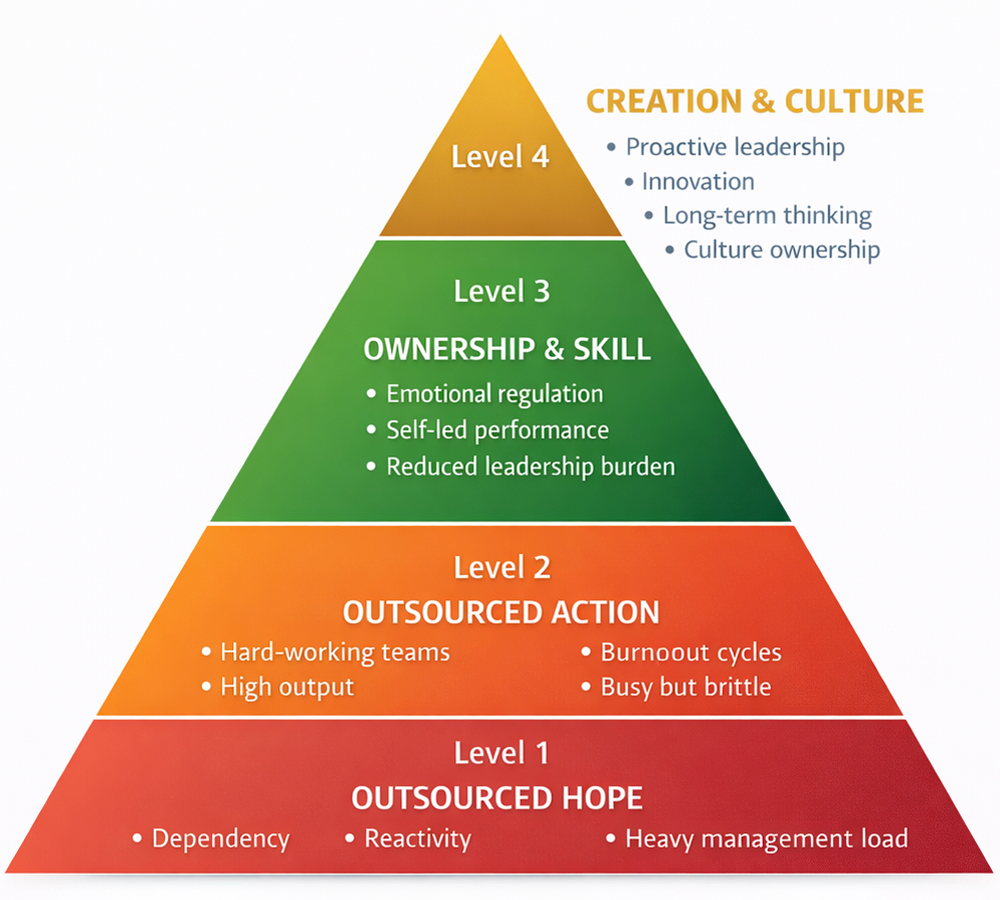
The Four Capacity Levels Inside Organisations
Organisations are not broken.
They are operating at different levels of internal capacity — and each level produces predictable behaviours, outcomes, and limitations.
Understanding these four levels helps leaders see why some initiatives work temporarily and why others create lasting change.
LEVEL 1 — Outsourced Hope
Behaviour: Dependence on others for solutions.
Organisational Impact: Heavy supervision, reactive work, and repeated frustration.
This level appears in teams that need constant direction and can’t self-generate clarity.
LEVEL 2 — Outsourced Action (Where most organisations are)
Behaviour: People work hard, follow systems, and comply — but still depend on external structure to perform.
Organisational Impact: Short bursts of activity, burnout cycles, leadership holding the system together.
Traditional wellness perks, team challenges, or “done-for-you” solutions may produce short-term engagement, but they do not change how people internalise responsibility — which is why the same problems recur.
LEVEL 3 — Ownership & Skill
Behaviour: Individuals take responsibility for how they respond to pressure, not just what they do.
Organisational Impact: Self-led teams, reduced micromanagement, faster self-correction, increased leadership bandwidth.
At this level, people have the internal frameworks — mental, emotional, physical — to operate sustainably.
LEVEL 4 — Creation & Culture
Behaviour: Proactive leadership.
Organisational Impact: Innovation, culture ownership, long-term strategic thinking.
This is not a starting point — it is an outcome of Level 3 capacity building.
Level 4 organisations are built by Level 3 people.
THE FOUR CAPACITY LEVELS
Every Organisation Operates at a Capacity Level, Whether It’s Aware of It or Not
Why Level 2 Strategies Stop Working
(And Why the Tools Aren’t the Problem)
Most organisations do not fail because they choose the wrong tools.
They fail because they use Level 2 tools in isolation, without the internal capacity required to sustain them.
Let’s be very specific.
Level 2 strategies are typically outcome-based and externally driven.
They focus on what to do, not who someone needs to become in order to sustain it.
Common examples include:
-
Prescribed meal plans
-
Generic or even personalised workout plans
-
Blood tests and biomarker reports
-
Wearables and tracking dashboards
-
Meal prep services and “done-for-you” nutrition
-
Fitness challenges and step targets
-
One-off health assessments
-
Resilience talks or information sessions
None of these tools are inherently bad.
In fact, many of them are useful.
The problem arises when they are packaged as solutions, rather than used as supporting tools inside a larger capacity-building framework.
At a Level 2 mindset, these tools are marketed as relief.
“For the busy professional.”
“You don’t need to think.”
“We’ll do it for you.”
“Just follow the plan.”
“Perfect for high-performing people.”
This messaging praises a lack of capacity instead of addressing it.
The result is predictable.
People comply while the structure is present.
They perform while the system holds them together.
They see short-term outcomes.
But nothing internal changes.
They do not learn how to:
-
Regulate stress without external control
-
Make decisions when conditions change
-
Recover when life disrupts routines
-
Adapt when structure is removed
So when pressure increases, or when the program ends, the outcome collapses.
This is why organisations repeatedly see the same pattern.
A wellness initiative launches -> Engagement is high -> Results look promising.
Then, quietly, things revert.
Not because people didn’t care.
Not because the tools were wrong.
But because capacity was never developed.
Here is the critical distinction.
A Level 4 mindset does not reject Level 2 tools.
It simply refuses to treat them as the solution.
From a Level 4 perspective, tools like meal plans, training protocols, health data, and structured interventions are used intentionally, within a Level 3 capacity-building process.
In other words:
-
The tools support the work
-
The tools do not replace the work
A holistic strategy integrates:
-
Physical tools, such as training and nutrition
-
Mental skill development, such as decision-making under pressure
-
Emotional regulation skills, such as stress awareness and recovery
The focus shifts from:
“Follow this plan”
to
“Understand how your body, mind, and emotions work, so you can adapt any plan.”
This is the difference between dependence and autonomy.
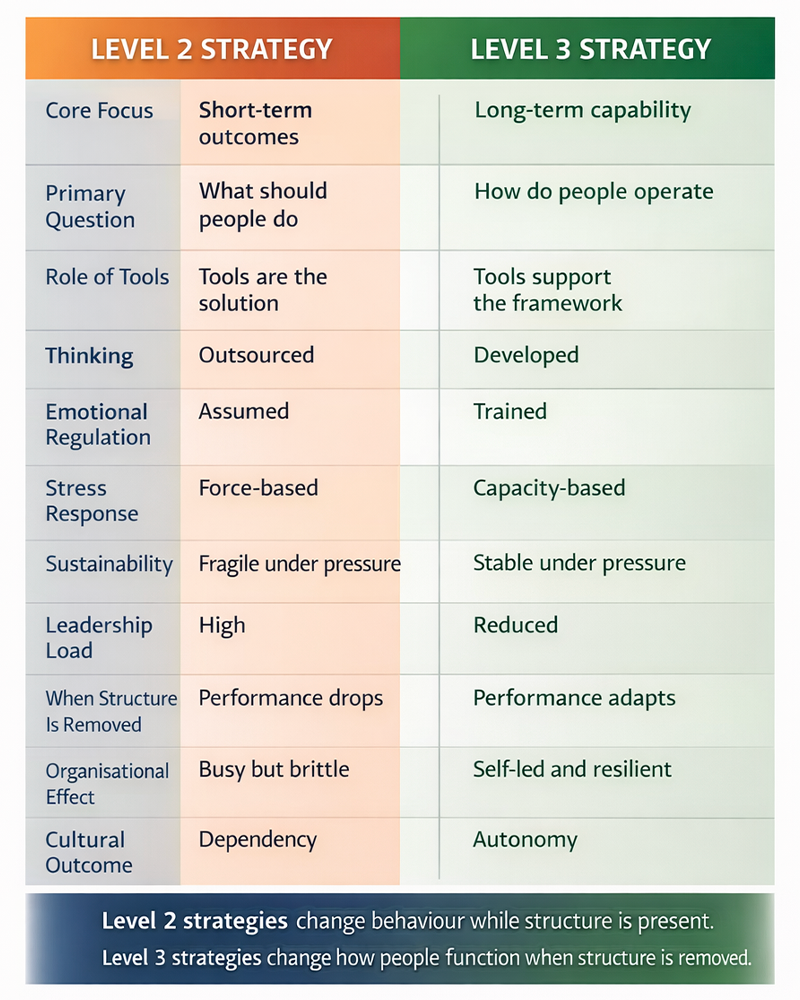
Level 2 strategies ask,
“How do we get people to comply?”
Level 3 strategies ask,
“How do we develop people who can self-lead when conditions change?”
Level 4 strategies then use tools strategically, not reactively, to support long-term performance, health, and stability.
When organisations only invest in outcome-based tools without developing internal capacity, they unintentionally create fragility.
When organisations invest in capacity first, tools become powerful amplifiers instead of temporary fixes.
This is the shift most organisations have never been shown how to make.
LEVEL 2 vs LEVEL 3 COMPARISON TABLE
Why Working Harder Stops Working
The Solution: Capacity Development
(How Tools Are Used Correctly)
The Kaizen Wellness Method does not remove tools.
It repositions them.
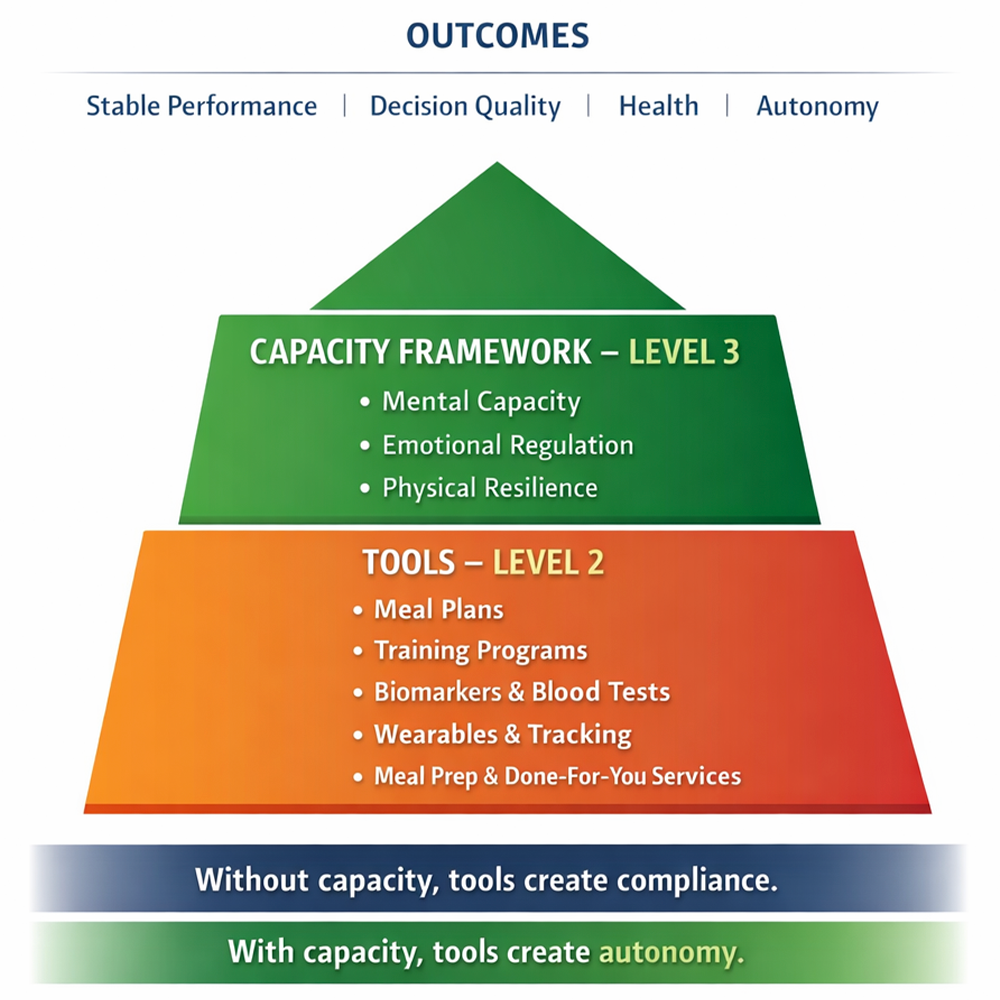
In most corporate programs, tools are treated as the solution.
Plans, data, and “done-for-you” services become the focus.
In a capacity-driven framework, tools become supporting instruments, governed by understanding rather than compliance.
Here is how the integration works.
Tools Serve the Framework, Not the Other Way Around
Training programs, nutrition guidance, health data, and structured interventions are used intentionally, but they are never applied in isolation.
Each tool sits inside a Level 3 capacity-building process that develops the individual’s ability to:
-
Understand why the tool exists
-
Apply it contextually
-
Adapt it when conditions change
-
Maintain outcomes when structure is removed
This immediately shifts people from dependency to autonomy.
Physical Tools Are Used to Build Awareness, Not Control
Workout plans, movement protocols, recovery strategies, and nutrition guidance are introduced as learning environments, not rigid rules.
People are taught:
-
How stress, sleep, and workload affect physical performance
-
How to adjust training and nutrition based on capacity, not force
-
How to recognise early signs of overload before breakdown occurs
The goal is not perfect adherence.
The goal is physical self-regulation.
Data Informs Decisions, It Does Not Replace Thinking
Blood work, biomarkers, wearables, and tracking systems are used as feedback, not instruction.
Participants learn:
-
How to interpret data without anxiety
-
How to separate signal from noise
-
How to make informed decisions instead of reacting to numbers
Data becomes a conversation starter, not a command.
Mental and Emotional Skill Sets Are the Core of Integration
This is the critical difference.
Tools only become sustainable when people develop the internal skills to use them.
The framework actively builds:
-
Emotional regulation under pressure
-
Cognitive clarity and decision-making
-
Stress awareness and recovery strategies
-
Habit formation without force or guilt
These skills allow any tool to be used effectively, regardless of changing circumstances.
From Compliance to Competence
When tools are integrated through capacity development:
-
People no longer “fall off” when structure changes
-
Leaders stop carrying the system for others
-
Performance stabilises instead of oscillating
The organisation shifts from:
“Follow the plan”
to
“Understand the system.”
This is what allows Level 2 tools to produce Level 4 outcomes.
Not because the tools changed,
but because the people using them did.
The Result
Tools stop being temporary fixes.
They become amplifiers.
Capacity becomes the foundation.
Tools become leverage.
That is the difference between another initiative
and a genuine performance upgrade.
In A Nutshell... What Changes When Capacity Is Built
When internal capacity grows, organisations experience:
-
Reduced burnout and sick leave
-
Greater autonomy and accountability
-
Higher retention of high performers
-
Increased leadership effectiveness
-
Stable performance even under pressure
-
Less reliance on micromanagement
This is not a morale boost — it’s a performance stabiliser.
How the Framework Is Deployed
The Kaizen Wellness Method is delivered through cohort-based implementation with intentional design:
-
Leadership alignment and readiness assessment
-
Selected organisational cohorts
-
Clear start and finish
-
Structured learning + coaching + integration
-
Self-selection, not forced participation
This protects outcomes, prevents initiative fatigue, and ensures real capability growth.
My Personal Invitation To You
Develop People Deeply Enough to Meet the Reality of Modern Work
The cost of insufficient internal capacity already exists — in turnover, burnout, leadership load, and repeated strategy resets.
This framework consolidates that cost into a strategic investment that builds capability from within.
Book a Strategic Capacity Conversation
No pressure. No obligation. Alignment first.
FREQUENTLY ASKED QUESTIONS
Is this a wellness program or a performance program?
How is this different from traditional corporate wellness initiatives?
We already offer gym memberships, wellness days, and EAP support. Why would we need this?
Is this suitable for all employees in the organisation?
What if some employees resist or disengage?
How much time does this require from participants?
Will this add more pressure to already stretched teams?
Is this coaching or training?
How do you measure success or return on investment?
Why does this start with a conversation instead of a proposal?
Why is this priced higher than traditional wellness programs?
What happens if we do nothing?
What makes this a Level 3 strategy specifically?
How long before we see impact?
Is this relevant outside of health and wellness?
What kind of organisations does this work best for?
This framework is not about fixing people.
It is about developing them to meet the reality of modern work.